
Photo by Navy Medicine on Unsplash
I walk up to a 1970’s, concrete block building with glass windows floor to ceiling. I look at my phone to confirm the address, trade sunglasses for eyeglasses, and walk through the front door to meet a toilet seat with handlebars sitting atop a white podium five feet high like a throne to disability. Rows of walkers, wheelchairs, and canes surround the toilet in concentric circles like worshipers praising their deity. The rest of the display room includes full-scale bathtubs and showers with built-in seats and handlebars, propped up against the walls and reaching to the ceiling like giants.
“Can I help you?” A desk attendant asks. I limp up to the counter, my left ankle injury surging with a sharp pain. “Yes, I’m here for the CPAP training,” I say. Three other men wait on benches to my left, each with white hair, one with a cane. Two men whisper in privacy, the third stares at his phone with a scowl, then a bald 40-something man with a white collared shirt, khaki pants, a belt cinched up to his waist, and a holster with a scan gun, walks up to the counter.
“All right, I’ve got Jack, James, Bob, and David for a 2:00 CPAP session?” The other men stand up. I raise my hand. “Ok, gentlemen. Follow me, single file, you know the drill.” We follow him back to a room with an L-shaped table. Three piles of medical equipment booklets, yellow pads, and empty black briefcases sit atop the table. I take the spot to the far left so that I’m not in the middle, surrounded by others.
“Welcome, welcome, welcome, to the beginning of your next sleeping lives, gentlemen. Take a seat, grab a pad and pen, and inhale the knowledge. We’ve got a lot to get through in two short hours.” I sit down and start flipping through the medical booklet entitled Medical Equipment Orientation Handbook, a rough 61 pages long.
“My name is Hayes, your Clinical Assistant. I’ll be with you for your entire CPAP journey, from today until you die–unless I die first.” I give him a sly grin, but the rest of the room is silent. “Tough crowd. Ok, we’ll stick to the script. Please open your booklets to where the handy dandy forms are sticking out at the top. These are called bookmarks.” I flip to the bookmarked page and scan the form.
“Ok, look to your left. Now look to your right. The first form you will sign today acknowledges that those gentleman you just saw may hear some of your health information and you’re ok with that. If you do not agree, I am obliged to schedule a separate training for your ears only and you will be escorted out at this time to the scheduling desk. Anyone want a private training?” Hayes leans in toward his audience with a raised eyebrow. I glance at the other men in the room, then quickly return my gaze to the paper. Everyone already knows we’re each here for sleep apnea and CPAP, and I don’t want to break up the band with an awkward exit stage left, so I sign the form in silence.
“Okaay, thank you gentleman. Once you’re done, place the form neatly in this basket as I pass it around and then turn to the next form in line.” He presents the basket in his right hand slow and with flare, while his left hand is suspended in air in a performative gesture like a magician with his hat.
“Voilà! Next up, a very I M P O R T A N T N O T I C E regarding your health insurance compliance. If you fail to meet your insurance company’s compliance requirements for using your equipment and providing data about its use, you will be required to purchase your equipment yourself or, if you choose not to purchase your equipment, to pay $122 per month in rental fees up to the time of termination and then you must return the equipment undamaged.” I take a deep breath and hold onto it to let the potential cost settle into my lungs. Hayes continues.
“To become compliant, you must meet the following criteria PRIOR to the 91st day of your equipment rental:
- Use your machine greater than 4 hours per night for at least 70% of the nights within any 30-day window.
- Complete a face-to-face visit with your doctor about your CPAP experience after day 31 and before day 90 of your rental timeline.
- Provide your data to your medical equipment supplier (ala moi) and your physician prior to the 91st day of your equipment rental.
- Repeat the above steps every 90 days until your machine is fully paid off.
- Once the equipment is fully paid for, repeat the above steps once per year to continue having your insurance pay for supplies and equipment replacement.
“But Hayes, you ask, how do I get my data to you? What if my doctor can’t see me exactly within this certain timeframe? Very good questions, I’m glad you asked. Lucky for you, your data will be automatically sent to us if you download our handy dandy mobile app and sync it with your machine. Easy peasy, let us do all the squeezy for you. And if your doctor cannot meet within the specified timeframe, please call the number shown on this page and ask for the Validation Team who can coordinate a separate time with your insurance to ensure you remain compliant. Any other questions, my friends?”
I look up at Hayes, then down at the instruction booklet, then over to the others with blank faces, then down at my yellow notepad with a hundred pages of blank space, then back up at Hayes. The tension in my neck and shoulder blades spikes as I lean forward, hanging on Hayes’ question for questions, feeling I’m missing something and I should definitely have questions, but nothing comes to mind except a headache.
“Alllllllll righty, then,” he says. “The crickets hold the floor. Please sign your acknowledgment to the insurance compliance and let’s move on.” Hayes moves swiftly to a side table and picks up a box, slings his scanner gun from its holster, and scans the barcode on the box. “Mr. Lister?” I raise my hand and he lays the box down in front of me. “This is your equipment, sir. Configured specifically for you by your doctor. Congratulations!” I look up for applause, but the crickets hold the floor again.
After laying each box out for the trainees, Hayes displays the equipment for us piece by piece, wearing the oxygen tubing like a snake around his shoulders, showing how it connects to the CPAP machine, how the head gear attaches to the tubing, and then explains the different settings for air pressure on the touchscreen. He recommends leaving the settings as-is since they are currently set for a pressure designed by our doctors and based upon our sleep test data. Then he shows us the air filter inside the back of the CPAP, the water canister that attaches to the side and is used as a humidifier, and finally the headgear with five individual pieces itself.
“Ok, time to expose those personal health details,” Hayes says. “But don’t worry, it won’t hurt. If you gentlemen can review your booklets privately while I speak with contestant number 1 for a moment, I will be right with you.” Hayes speaks with me first, asking me about my sleep style, congestion levels, whether I sleep on my back or side, how bad my snoring is, whether I have any health conditions like my EDS that can impact sleep apnea, which kind of sleep apnea I have, whether I have a deviated septum, and more. He measures my head, looks at the size and shape of my nose, asks if I have thoughts on a nose pillow versus full facemask, whether I have issues breathing through my nose, and various other questions lost in my memory. At the end of the interview, he recommends I try nose pillows instead of a full face mask, then slings his scanner gun out of its holster to scan some plastic bags with the applicable head gear. The tension in my neck is at a level six now, the headache a level four, and my anxiety at eleven. I investigate the equipment as he interviews the others. After he finishes, he turns back to the front of the room. “Ok,” he says. “Now it’s time to try on your masks and give the oxygen flow a go.”
He warns us the air pressure may feel strange, and we might have trouble breathing at first. The bitter irony of the situation suits the solemn mood hanging in the room, despite Hayes’ many attempts to make us laugh. So, as demo-ed by the master, I push the pillows gently into my nostrils, then wrap the harness around the top of my skull, down the temples, and under the chin. Then I click the pillows together like a seatbelt on my nose. They are a malleable silicone material that fold and bend to align with the shape of my nostrils. When the oxygen is first turned on, the pressure feels like a punch of wind to my nostrils. I need to open my mouth to take a gasp of air, but then the oxygen is sucked from my nose down into my throat instead of into my lungs and I start to choke and cough, and I rip the mask off.
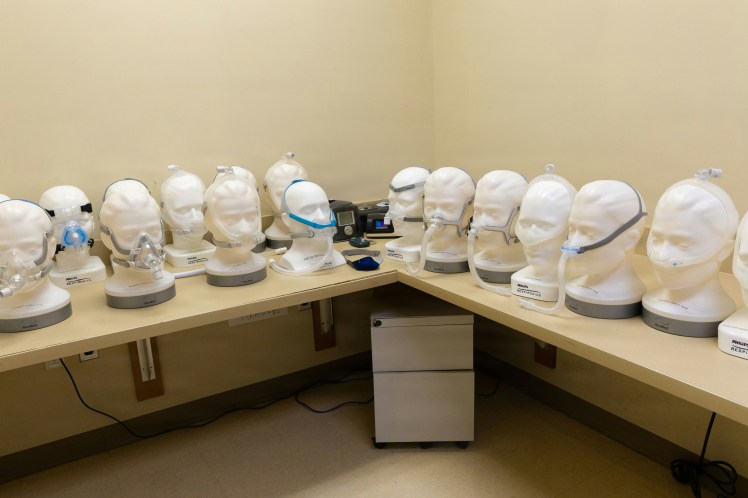
“Ok, ok, that’s normal,” Hayes consoles me. “Next time, lower the pressure until you get a better seal on the nose, then gradually increase it, keep your mouth closed so that it doesn’t disrupt the airflow, and then breathe slow and deep in and out through the nose. This chin strap might be a good idea to use until you get used to the air pressure so that you keep your mouth closed.” He displays a cloth wrap on top of a mannequin head that folds underneath the chin, up the sides and over the top of the head and is attached with Velcro to keep the mouth from opening. I grab it, wrap it around my head like a mummy, and look at Hayes again, unable to speak.
“Try again,” he says. “You can do it.” I reapply the nose pillows, turn the air on, keep my mouth closed, and breathe deep, heavy, and quick in and out through my nose, as if I’m trying to race the air pressure and beat its speed and hyperventilating. Hayes lays his hand gently on my shoulder. “Look at me and slow your breath… iiiiiiinnnnnnn and ouuuuutttt…” I breathe deeper in through my nose, slower, and focus on keeping my lips closed, unable to thank Hayes for his calming gesture because if I open my mouth, the oxygen will get sucked in through a wind tunnel and I’ll start choking again. Eventually, I find a rhythm, but the air pressure still feels fierce and fast so that I must focus on breathing deeper and more labored, rather than the natural unconscious effort it used to be. I am now a deliberate and measured breather.
The rest of the training takes almost two hours, addressing equipment replacements, cleaning and maintenance, insurance compliance (including what happens when switching insurance), traveling with equipment, etc. It’s overwhelming, but I’m also grateful that a medical equipment company provides such detailed training on how to use their machine so that I maintain it properly, how to communicate with them, my provider, and my insurance company for compliance purposes, what to do for resupply of equipment due to the number of parts and recommended replacement frequency. I must set weekly and bi-weekly reminders on my phone for cleaning and part replacement. This will be the routine for the rest of my life.
As I leave the training, I have a briefcase full of equipment that weighs roughly 10 pounds, including the CPAP, extra samples of air filters, nose pillows with different sizes, and two pieces of headgear in the event I need to try a different style. I question whether all of this will ultimately be worth the investment of time, money, and resources, whether equipment maintenance, tracking due dates for replacement parts, regular notices to insurance, and tracking data for doctors, will end up counteracting the supposed better sleep and energy that I will derive from using the equipment (and assuming I use it correctly). In the end, even with successful use of the CPAP, my EDS and spondyloarthritis may still cause me to get poor sleep and wake up just as exhausted as before I started, but at least with improved oxygen flow during sleep, I will have a healthier heart.
So, I look at my phone to order a Lyft home, then walk out into the rain. As raindrops drip off the brim of my hood, my new breathing briefcase hangs on my right shoulder and tugs on the tension in my neck. It cinches up my arm like a rope as I suck in a surge of pain through my lungs. Slow and deepen your breath, I hear, so I breathe in deeply through my nose, and then release.
Copyright 2026 David Lister. All Rights Reserved

