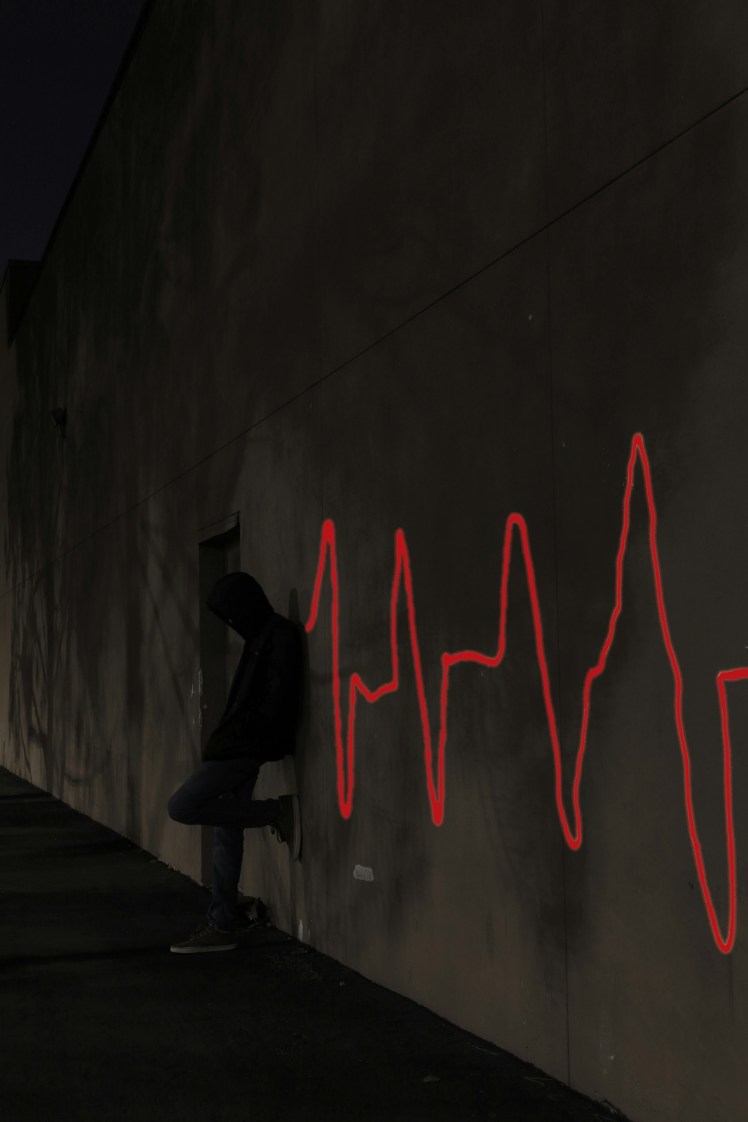
Photo by Ty Tomlinson on Unsplash
As I lie on my back on an exam table, electrocardiogram wires entangled across my wrists and ankles, I scan the room of my new rheumatologist for clues to his methods. This is the second specialist I have seen in over a year after receiving a diagnosis for a second joint disease, coupling my hypermobile Ehlers Danlos Syndrome (hEDS) with a fresh Spondyloarthritis (SpA).
On the walls hang the standard doctoral certificates, artwork of joints describing how they function, and an unorthodox shadowbox with an aged and brownish human bone with a card inside that reads, “Hip bone of the last patient that didn’t take my drugs.”
“I’m going to turn the light out,” the nurse says. “The test is supposed to be done in a calm setting, but don’t fall asleep.” He starts to exit, pulling the door behind him before leaning his head again, the door frame cutting off his body. “And don’t move.” Then the door shuts.
My heart begins to race as I imagine what might happen if I fall asleep in this room. If I move too much, will I skew the data? Will it be unusable? Misleading? Or all the above? I close my eyes and take a few deep breaths, but then my right eye starts to twitch. And then I picture Google maps on my car console, leading me a block further down the road than my destination and making me five minutes late to this appointment, and the fear I had walking up to the clinic that I might be turned away because they had too many patients on the schedule and could not wait for me even after I waited three months and 45 minutes in traffic to get here.
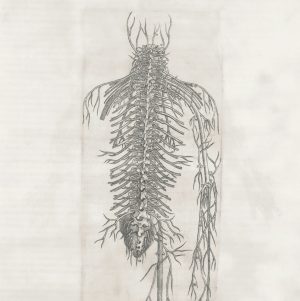
My heartbeat flutters inside my chest like a concert pianist’s glissando, his fingers gliding down my veins. I breathe deeply again, trying to calm the pianist’s fingers down to a slow pianissimo. I only have five minutes to complete the test. Designed in the 1960’s and 1970’s by Russian doctor Roman Markovich Baevsky to test on astronauts in space, the Baevsky Stress Index is “a quantitative metric used to assess the activity of the autonomic nervous system, specifically tracking sympathetic nervous system dominance (stress).”1 The autonomic nervous system manages bodily functions that you do not have to think about to control, such as heart rate, blood pressure, digestion, sweating, and breathing. And one side of this nervous system, the sympathetic nervous system (SNS), includes a group of nerves that activate the fight-or-flight response of your brain. If you are in danger or under stress, the SNS kicks in, speeds up your heart rate, and delivers more oxygen and signals to different parts of your body to remove you from danger.2
“Your sympathetic nervous system numbers are about 100 points higher than average,” the doctor explains to me.” This indicates an unhealthy autonomic system, or dysautonomia. And more specifically, I have a higher than active SNS.
“My sympathetic nervous system is too high?” I ask. “I’m just a sympathetic guy.” I shrug.
“Not exactly,” he responds.
“Well, I had an unusually stressful day at work this morning and was stressed out when I arrived. Could that skew the data?” I ask.
“A little, but not enough to normalize you.”
I look down at the numbers again. “It could bring your score down maybe 20-30 points,” he continues, “but still puts you about 70 points too high and in need of reducing your stress at rest.”
As a hEDS patient, the most likely form of dysautonomia that I suffer from is Postural Orthostatic Tachycardia Syndrome (POTS). According to Dysautonomia International, “POTS is a common autonomic nervous system disorder characterized by an excessively fast heart rate and symptoms of … lightheadedness, fainting, chest pains, shortness of breath, GI upset, shaking, exercise intolerance, temperature sensitivity and more.”3 I have experienced most of these symptoms since my twenties, and yet this is the first time anyone has tested me for dysautonomia, over twenty years after my initial symptoms. Dysautonomia International also indicates that “POTS patients are often misdiagnosed as having anxiety or panic disorder, but their symptoms are real and can severely limit a person’s ability to function.” I was also diagnosed with general anxiety disorder in my early twenties, a common misdiagnosis for POTS. While I definitely experienced anxiety as a young man, and my diagnosis may have been accurate at the time, if I had known about dysautonomia, its symptoms, and its association with hEDS, I might have had very different conversations about the direction of my healthcare from my twenties until today.
hEDS is also the most commonly undiagnosed form of EDS, and it took over thirty years of symptoms before I received a definitive diagnosis. The common theme here is misdiagnosis after un-diagnosis after misdiagnosis, resulting in a decades-long search for knowledge about disparate symptoms all adding up to firm hEDS and POTS diagnoses using a better-late-than-never approach. I have written about this issue before, about the gaps in our healthcare system that reduce the accuracy of diagnoses in patients and leave them feeling lost and searching for answers on their own. While I received a diagnosis of hypermobility in my thirties, I did not start learning about Ehlers Danlos Syndrome and the diverse types of EDS until many years later. And while I have always suffered from lightheadedness, exercise intolerance, fatigue, and other symptoms of dysautonomia, I never heard of it or POTS until recently, and only because I listened to other hEDS patients discuss it on social media groups. And while the Baevsky Stress Test has existed since the 1970’s and has become a global standard for heart rate research, last week was the first time anyone had introduced me to it or used it to test me for POTS, even though it is a very common condition with hEDS patients.
Many factors can lead to a frustrating outcome like this. I am not immersed within the medical community and therefore lack the scientific knowledge to understand relationships between symptoms. I have also been ignorant about symptoms indicating certain medical conditions, like exercise intolerance, a real physical condition in which the body cannot handle regular exertion for one’s age and size, leading to extreme exhaustion, shortness of breath, and pain.4 When I look back on my high school athletic career, I experienced severe fatigue, shortness of breath, and odd pains in my muscles when competing in soccer and basketball, but I avoided communicating this to teammates and coaches due to fear of judgment for being a weak man. I thought my body’s resistance to and pain during exercise was weakness rather than a potential sign of a medical condition. While the symptoms I experienced could have been for a lot of unknown reasons, a lot of patterns that I recall from my young adulthood make more sense after receiving diagnoses and learning about the common symptoms with each of my diseases.
While our healthcare system has a long way to go in terms of better communication between providers, sharing of information so that doctors can understand a patient’s health holistically, and breaking down cultural biases and stigmas like men hiding their pain, I have learned a lot from this recent, five-minute long stress test. The complexity of my diseases continues to startle me, and I recognize how much further room there is for medical research to make strides in understanding the human body. When an upset gut, over exhaustion during exercise, feeling lightheaded when I stand up from a chair, and my ability to act as a party trick by bending my fingers backwards to a horrific position, all can be caused by one medical condition that presents as loose joints, it tells a fascinating tale about the complexity of the human body. And it leads me to reiterate like I have discussed before how important it is to be honest and open to ourselves, to each other, and to our doctors about each symptom we experience, no matter how seemingly insignificant it may appear to us.
- Alauddin W, Radke PM, Janardhana N, Singh I, Sharma A, Arora S, Prajesh BR, Shree R, Shaikh Z. Heart Rate Variability and Intrinsic Autonomic Coupling in Ehlers-Danlos Syndrome. Cureus. 2025 Dec 8;17(12):e98693. doi: 10.7759/cureus.98693. PMID: 41523445; PMCID: PMC12781037. ↩︎
- The Cleveland Clinic. What is the Sympathetic Nervous System. 2022. https://my.clevelandclinic.org/health/body/23262-sympathetic-nervous-system-sns-fight-or-flight ↩︎
- What is Dysautonomia? Dysautonomia International. 2019. http://www.dysautonomiainternational.org/page.php?ID=34 ↩︎
- Jennifer Huizen. What is Exercise Intolerance? Healthline Media UK Ltd, London, UK. September 2023.https://www.medicalnewstoday.com/articles/exercise-intolerance. ↩︎
Copyright 2026 David Lister. All Rights Reserved.

